Around 2019 I started thinking about what the future brings. All these tools we already had, and all the tools that would soon be at our disposal. To anyone thinking about the topic it was obvious a change was happening: already with calculators, Google and mobile phones we entered a friendly relationship with technology that made things easy. So easy that we stopped remembering math, phone numbers, and details we could look up in five seconds.
But if you took a look at the near future in 2020, you could sense more was coming. And if you did, you were right. Today we are one foot in a sci-fi future, barely noticing the change is happening. Navigation, arithmetic, recall, and maybe soon anything we can envision no longer needs our effort. You know the old saying, “use it or lose it”. I think it is safe to say it applies to our future.
I wrote about this in 2020, in A Brave New Augmented World, mostly excited about what augmentation could give us. But all the while a sentiment stuck: we are growing dependent.
In 2026. LLMs do what we did not dare dream of just a year or two before. It might be time to start thinking about training and keeping the skills we are about to automate. We have been actively taking care of our bodies for years. It is time for the mind.
I know, I know. Gamification to force engagement, dark design patterns, users as the product, yada yada. Let’s do it differently this time. Open, transparent, honest about the uncertainties and problems, as anonymous as we can get without duplicating results over time, and in good faith a positive sum game.
Enter Excogni, a cognitive gym.
What it is
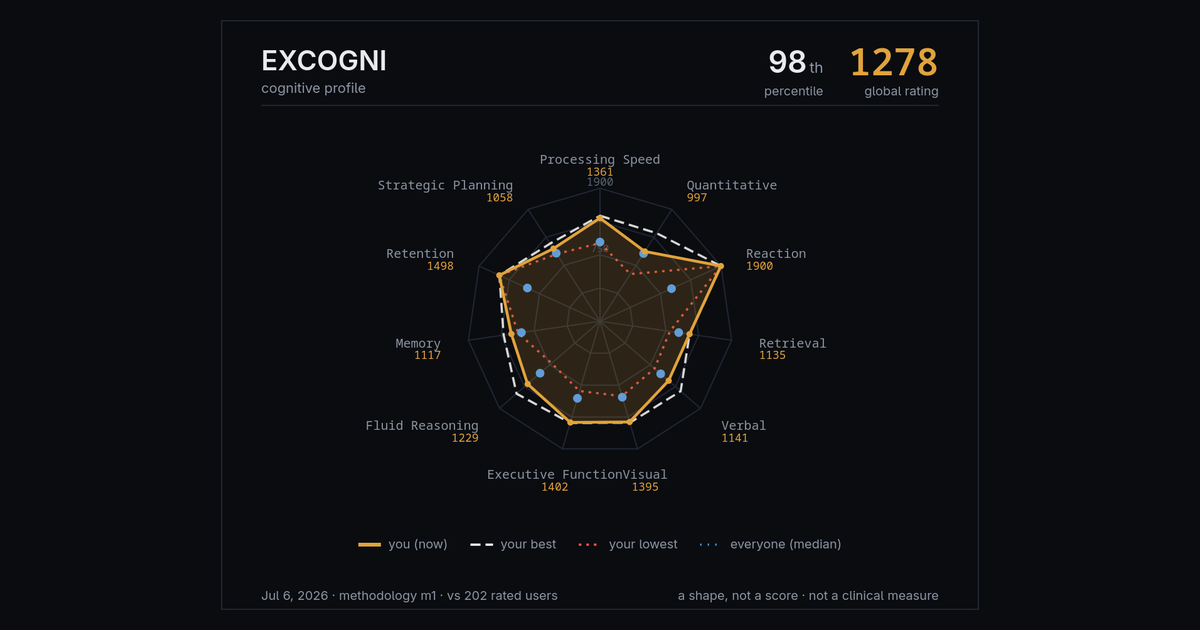
From working memory and mental arithmetic to inhibition, task switching and strategic planning. Adaptive difficulty, so it quickly finds where you are and grows with you as you progress. The core idea: every attempt both trains and measures at once. You practice, and the practice itself is the measurement.
What you get is not a simple number, it is a shape through time: your abilities mapped visually, some strong, some weaker, changing from session to session. A stream, not a snapshot.
Open
The code is AGPL, at github.com/xcgni/xcgni. Self-hostable with one docker compose command. But open code is the easy part. The scoring formulas are published in the app itself, on the methodology page, versioned: changing a formula results in a new methodology version instead of silently rewriting history. If a number ever surprises you, you can read exactly how it was computed, and by which version.
Honest about the problems
The methodology page has a limitations section. The sample is self-selected. The sessions are unsupervised. Practice can improve ratings, not just ability. Since this is true for all repeated cognitive tests, we record every attempt and mark first-time exposure so the learning curve can be separated from training. The changelog is public too, on the site, the same file that ships in the repository, mistakes included. An instrument that hides its own failures is not much of an instrument.
Hard to connect to an individual
You can practice without an account at all, and anonymous practice stays entirely yours. If you register, you get a link in the email and nothing more, and here is the rad part: we cannot leak your email, because we do not keep it. When you type your address at login, it is used in that moment to send you the link, and what the database keeps is only a keyed one-way function derived code computed from it. No readable address exists anywhere in our data, not even in your own data export, email as in identity is decoupled. The honest cost of that design, some would say bonus, is that we also cannot email you, ever. No newsletters, no “we miss you” nudges, only the login links. I think the trade is more than fair.
The public statistics have a hard anonymity floor: any group smaller than fifty people is withheld, always, and shown as withheld rather than omitted, because a gap is information too.
Positive sum
Here is the catch. xcgni.com is shiny and polished to an extent, and it is a viable training tool on day one. But without consenting users, the population numbers are all just decorative. Percentiles need a population. The statistics page, the group explorer, the researcher dataset with its citation block, all of it becomes real only as people opt in.
So the pool is the commons. Registering and ticking the research consent is what makes your results count toward it, and everything the pool produces is free for everyone, including those who pay nothing and those who only ever practice anonymously. When someone contributes, they keep the commons open for all.
Ideally this gets extended by the tech and scientific communities. Errors rectified, logic extended, methodologies updated and verified. Communities are stronger than individuals. That would be ideal. But I was not going to wait for someone to build me the tool in the coming years. I was going to give it a push, and here it is.
And here is the hope underneath it all: that someone does actual science with this, or on this. The aggregate dataset is citable, the schema is documented, the collection conditions and confounds are stated on the page, and the whole data-generating process is inspectable because the instrument is open source. If a student somewhere tests a hypothesis on it, or a lab tears the methodology apart and publishes something better, the project already did its job. I would rather be corrected in public than trusted blindly.
The money part, said plainly
No ads, and no selling of individuals’ data, ever, at any price. That one is absolute. The aggregate statistics are already free for everyone, and no paywall touches the commons. If one day a research lab wants a custom cut of the anonymized aggregates, or a commissioned analysis, that could reasonably be paid work, and I am saying so now rather than surprising anyone later. The instrument, the statistics and the methodology stay free for all, that is the point of the whole thing.
How it survives instead: there is a support page for those who want to help keep it running - not yet operational - and I plan to charge a symbolic price for the mobile apps, which add conveniences like reminders on top of the same free instrument. Nothing measured ever goes behind a price.
And the honest ambition, so nobody feels led by the nose later: I intend to be the caretaker of this project, and I would not mind if one day it sustained me enough to not need additional jobs. If that day never comes, it stays up anyway. It is cheap to run and it is open source, so it can outlive my wallet either way.
What it is not
It is not a medical instrument and it does not diagnose anything, but I can see the potential for it to become one with time. It is not validated psychometrics yet: test-retest reliability and external validity are the stated next steps, and they will be published from the same data, openly, once repeat volume permits. Until then it is exactly what it says: an honest instrument, early in its calibration, that tells you its uncertainty instead of pretending it has none.
Final Word
This is not the final evolution of this product - this is the point where I want it public, not the point where it is done. There is a road ahead, and it would be nice to see it grow, ideally with more hands than mine.
Somewhere around 2019 I started worrying that the easiest future is the one where we quietly stop using our minds. Back then I could not measure it. Now I can, and so can you.
Try it without an account: xcgni.com. If it turns out useful, a login with an email, which we will not keep, makes your results count for everyone.